The Cost of a STEM Education

Another major factor is simply the cost of a science and technology education – you can’t learn computer science without a working computer!

Technology has shaped education and how students learn – many teachers are opting to use online assignment submission, encouraging students to download lessons from a school website, and communicating to their students via Twitter. I still remember going to the computer lab with my class to play Math Circus, a series of circus mini-games geared to teach children math.

There are also so many free resources available for educators that can supplement their lessons and help students. Many of these resources are available through an app on a mobile platforms but what about schools and communities that don’t have the funds to access such technology?

Some schools have a Bring Your Own Device program to save the cost of buying a class set of tablets or laptops. Some schools discourage this program because it is not guaranteed that all students will have a device so they will purchase their own technology.

Technology Supports Inquiry Learning:

Whilst technology may have been a ‘want’ ten years ago, now it is a ‘need’ for educators as more provinces and school boards make 21st Century learning skills and inquiry skills a requirement for classrooms.

Inquiry-based learning is a pedagogy that is focused on learning using constructivism, which involves an individual’s participation to facilitate their own learning. In other words, a student must be engaged, actively thinking, asking questions, making connections between their knowledge and real-life examples, and use hands-on activities to concretize their theoretical knowledge (Minner, Levy, and Century, 2010, p. 476-476). In fact, inquiry-based learning has been shown to improve grades in physical science courses for non-STEM students (Hemraj-Benny and Beckford, 2014).

Inquiry learning is a fundamental aspect of science education since the nature of the subject is to ask questions and use what you know to develop a way to answer your question.

Even if a school can afford computer carts or tablets, there are recurring costs in a science department.  In a science department equipment such as glassware, reagents, and rats for dissection must be replenished every year in order to do experiments.

Experiments support a student’s inquiry skills which are important for a budding scientist but with the high cost associated with science experiments, how can students learn?

As previously mentioned in another blog, I struggled to understand physics so I only fully grasped it when I did the experiments. I was lucky to have a teacher that did an experiment at the end of every unit and to be in a well-equipped physics classroom with an air track, metal carts, optics equipment, and PASCO sensors. I cannot imagine passing my high school physics classes if I didn’t have the resources available.

What Can We Do?

There are many government funded outreach programs that bring science experiments to your classroom for free. Quite often, university students volunteer to visit the classroom for a workshop and they will bring all the necessary equipment to perform an experiment.

In my school we frequently had visitors for McMaster science and engineering outreach programs to do a specific experiment for that day. During one of these visits, each group of students were able to build their own circuit and create a solar car that we later tested outside.

There are many programs like this all around Canada and a lot of them are affiliated with a post-secondary institution so it can double as a career-planning workshop for your students. One of the biggest outreach programs and an incredible resource for science educators in Canada is Let’s Talk Science. Let’s Talk Science conveniently provides a page dedicated to finding a local outreach:

In terms of technology, there are a lot of grants available from some of the biggest companies in Canada such as the Best Buy School Tech Grant which also has a specific STEM school category and the Staples Superpower Your School Contest for environmentally conscious schools. Check out our AYVA grant page to see what’s available!


References:

Hemraj-Benny, T., & Beckford, I. (2014). Cooperative and Inquiry-Based Learning Utilizing Art-Related Topics: Teaching Chemistry to Community College Nonscience Majors. Journal of Chemical Education, 91, p. 1618-1622

Minner, D.D., Levy, A.J., & Century, J. (2010). Inquiry-based science instruction—what is it and does it matter? Results from a research synthesis years 1984 to 2002. Jouurnal of Research in Science Teaching, 47(4), p.474-496.

What Prevents Students from Pursuing STEM (And Why I Pursued It Anyway)

Article after article highlights the lack of diversity in STEM – not enough women, not enough racial minorities, not enough people from lower socioeconomic classes. There are also articles that dispute that the STEM gender gap doesn’t exist and that there are equally as many female STEM graduates as their male counterparts (that will be covered in a future blog).

Numbers aside, today I will be covering a few reasons why students don’t feel that a STEM career is an option for them and how I pursued one despite these reasons.

Some of the commonly cited reasons for students avoiding STEM are the lack of role models in these fields, peer pressure, and overall perception of STEM.

So why do people avoid STEM?

Students typically dismiss science educations because they do not see many role models that they identify with in this field. They feel that they would not fit in or underestimate their skills to pursue such a degree.

In a study by Microsoft, it was determined that having effective role models and support from parents and mentors are needed for females to see themselves in a STEM role. Exposure to STEM activities and real-world applications also influenced how females perceive STEM jobs and their class choices later in their life.

Although this study focused on women in STEM, these environmental factors can also influence students of different ethnicities, orientations, and abilities. Everybody has a different identity – it is important to realize that not one person fits into one single group. But the approach to encourage more students to pursue a science education is the same: good role models, a support system from educators and family, and exposure to science in different contexts.

Why I Still Ended Up in STEM

Although I had decided that I wanted to study science in high school, I nearly didn’t go into chemistry. My high school had a large proportion of students taking at least one senior science and many graduates pursued post-secondary educations in STEM. Science was something that all of my peers were doing and it was something that I excelled in so I decided to take all three courses offered (biology, physics, chemistry).

I loved my chemistry class – I did extremely well and it was so interesting to me. However, I was considering biology as a major because I didn’t excel in grade 11 physics and a chemistry major relied heavily on some physics concepts. Half of my friends were going into biology or healthcare but I couldn’t find a biology major that I was really interested in and I definitely did not want to go into nursing. At the time I was worried about risking my university acceptance average by taking such a difficult subject like grade 12 physics.

I reluctantly took grade 12 physics after consulting with my physics teacher even though I could get into my desired chemistry programs without it. Only a few of my friends were taking physics and I felt like everybody in my class smarter than me. The majority of my classmates were going into either engineering, computer science or pure physics.

I had many people in my life that encouraged me to pursue a chemistry degree but it was my physics teacher that helped solidify my choice.

My high school physics teacher was female and she was one of the best teachers in the school. To see a woman teach one of the hardest courses in the curriculum was quite encouraging for me especially since I doubted my abilities amongst my predominantly male pre-engineering peers.

She always tried to do what was best for her students which included telling us some hard truths. Her class also humbled me – I learned how to fail in her class and come out better. Even though I didn’t do as well in her class compared to my other courses, I finished that course feeling like I earned the mark.

Because of her support, I was able to picture myself studying chemistry and to not fear physics. She was always open to providing extra help and giving honest advice on university program choices.

I also had amazing support from my female peers in that class – the class went from 25 students at the beginning of the semester to about 7 by the end of the semester. Half of the students left in our little group were female including me and the entire class became more of a study group than an actual class. The small class size and the fact that I was not the only girl in the room helped me persevere through grade 12 physics. All of the females in that class ended up pursuing degrees in the physical sciences or engineering.

That is just one example of how being taught by somebody and being surrounded by peers that I identify with empowered me to study chemistry. This is why support, role models, and outreach programs are vital for encouraging more underrepresented groups to choose STEM careers.

Despite this, there are still other major reasons other than underrepresentation as to why Canada doesn’t have enough STEM graduates which will all be covered in next week’s blog!

A Student’s Perspective on STEM Education: A Blog Series

Throughout the summer, AYVA will be launching a blog series all about the use of technology in STEM education.

My name is Katrina and I started at AYVA in January as a co-op student from the University of Guelph. I am a Biological and Pharmaceutical Chemistry major and STEM education has always been something that I am passionate about. I feel like I am in a unique position to help improve it through AYVA as a student who has recently experienced secondary science education and is currently studying science in university. I have some perspective on how technology can be used to improve learning having used PASCO technology both in high school and university.
Through this series, I will be covering some successes, issues, and perspectives on the status of STEM education in Canada along with my personal experiences as a STEM student in Canada.

Why does this series matter?

I am one example of how good teaching can truly inspire a student to pursue science and can make a significant impact on their educational choices and career path.

I was very fortunate to go to a high school in the Dufferin-Peel Catholic School Board that had an incredible science department. In that department, I have had various role models and mentors who helped me realize what I wanted to do.

Through these teachers, I have had so many opportunities to confidently pursue science. They helped me attend STEM outreach camps, provided extra help and resources, let me into their classroom after class hours to talk about advanced topics and issues in science.

My high school mentor helped my friend and me to pursue a graduate-level research project at the University of Guelph while we were still in grade 12 for a competition. How many people could say that they did that at 17? I owe a lot to my teachers for helping me achieve my goals and for guiding me to where I am today.

I also attended a high school that was relatively new and as such had many resources available for inquiry learning. We had SmartBoards, laptop carts, and PASCO equipment for our science department. This technology helped supplement my lessons and made me understand some more difficult concepts. The PASCO equipment in particular helped me quite a bit in my physics classes – it was the only class where I never fully grasped concepts until I did the experiments.

With that being said, I know that not everybody has access to a good science education. I know that I am fortunate to have gone to a school with teachers that have the resources to ensure that their students succeed. This is why I am writing this series – I want to highlight some of the key issues in STEM education and give insight using my own experiences. Through this, I hope that I can inspire others to push for better and accessible STEM education.

Jason Pilots Ice Cream Webinar: June 13, 2018

I scream, you scream we all scream for ICE CREAM!! Everyone loves ice cream and kids love making it.

In this presentation we look at how you can teach some kinetic molecular theory, intermolecular forces and even heats of reaction/calorimetry while making ice cream.

This lesson has been done with grade 9 applied level classes as well as grade 11 University Prep Chemistry. It can easily be tailored for senior physics and chemistry.

Students get a chance to see how state of matter affects temperature (using the PASCO Wireless Temperature Sensor), in real time, and how adding salt to ice can drop the temperature even further even though it is changing into a liquid! We then do some simple calorimetry with different forms of food to get an idea of how much energy is stored in them.

Jason Pilot is currently the Department Head of Science at Sir Winston Churchill C&VI in Thunder Bay, ON. He has been teaching Science for 17 years. Jason focuses on the integration of technology into instruction and assessment incorporated into problem and inquiry based experiential learning.

Engage Students with Personalized Learning Strategies

Bryan Ouellette is an Educator, Explorer and overall technology Enthusiast who enjoys discovering strategies that allow students the opportunity to investigate various concepts through personalized learning. With over a decade of classroom experience, District Lead Positions and Provincial Committees, Bryan is committed to transforming classrooms into an environment where learning happens willingly.

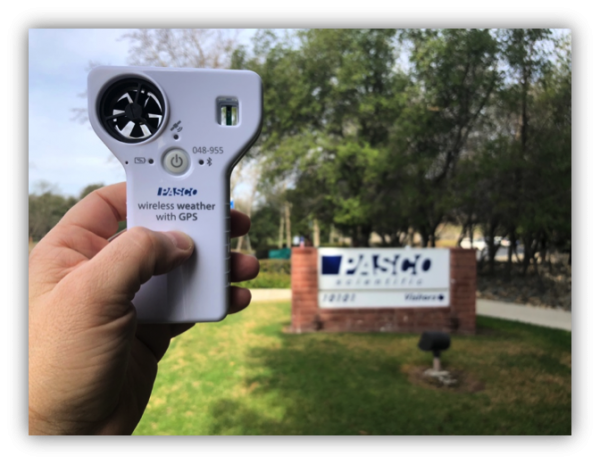
Bryan takes a look at the new PASCO Wireless Weather Sensor, how it works and how it can be used in classrooms. This journey will not only take you from the windy parts of the prolonged winter in New Brunswick, but also to depths of the abilities that this new PASCO Weather Sensor can provide.

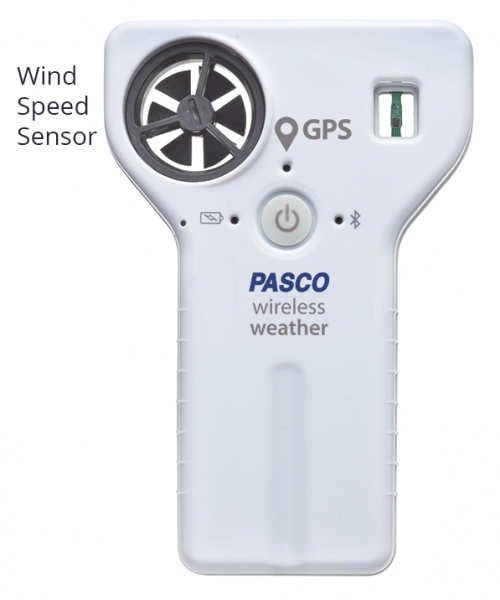
The Wireless Weather Sensor with GPS is an all-in-one instrument for monitoring environmental conditions. A built-in anemometer as well as sensing elements for temperature, humidity, pressure, light, and GPS the sensor provides up to 17 different measurements that can be used individually or simultaneously. Use the sensor in logging mode with the optional Weather Vane Accessory for long-term monitoring, or use it as a hand-held instrument to study microclimates and record ambient conditions relevant to many biological and environmental phenomena. Conduct GIS/mapping experiments using the onboard GPS sensor in conjunction with any of the other available measurements. The new map display in PASCO’s SPARKvue software provides a way for students to analyze spatial data.


Products shown:

What’s YOUR weather like today …

Students are familiar with the concept of weather – they likely use an app to see what it’s going to be like every morning to decide what to wear. But do they know the difference between weather and climate? How can we help them understand that weather refers to local conditions over a short period of time while climate identifies atmospheric behavior over longer periods of time?

We can start by having them measure “what’s happening in your neck of the woods”. The question shouldn’t be “What is THE weather like today?” Instead it should be, “What is YOUR weather like today?”

This change in context can help them understand that weather is local. The conditions that they experience could be very different not only from what someone experiences across the country, but even from what the weather is like just a few miles away.

Using the Wireless Weather Sensor with GPS you can measure and monitor local weather conditions. Simply take it outside, connect to SPARKvue, and start collecting data.

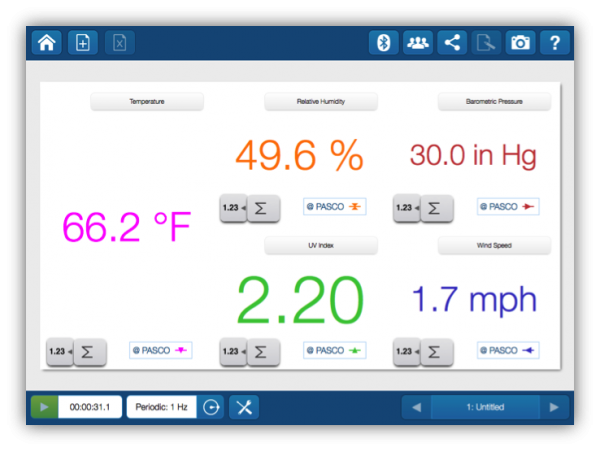
The sensor is capable of making 17 different measurements. To keep the data collection focused, you can set up a display to make the measurements look like a dashboard for your own personal (temporary) weather station

In SPARKvue you can change the units to match the units that are reported on actual weather stations. For example, in science we typically measure temperature in degrees Celsius, but weather in the US is reported in degrees Fahrenheit. This provides a good opportunity to talk about measurement units and how they are related.

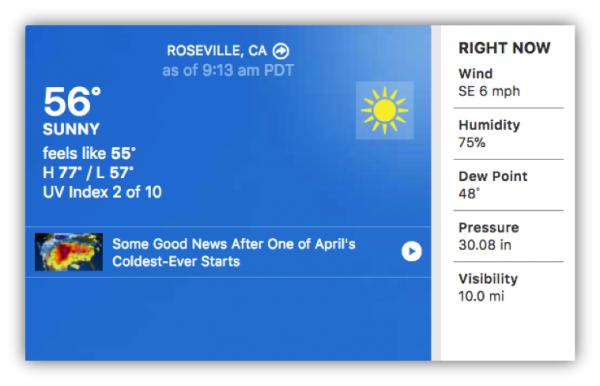
Once the students collect “their” weather data, they can check that against the forecasted weather for the area at the same time.

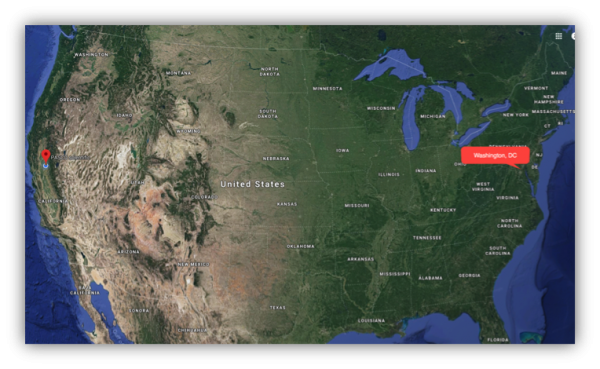
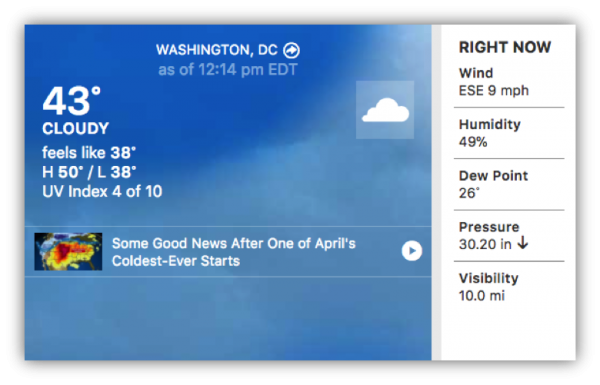
To get a broader perspective, students can compare “their” weather to conditions in other places at the same time. For instance, PASCO scientific is at a latitude of about 38.8 degrees north. Across the country, at about the same latitude, but a very different longitude, lies Washington, D.C.

The change in longitude, going from the West Coast to the East Coast, can mean very different weather.

Your students don’t have to travel across the country to see differences in weather. Having multiple students collect data at different areas around the school or home provides a great opportunity to analyze data and incorporate science and engineering practices into your lesson. They can analyze and interpret the data by comparing both to each other’s data from different locations around the school, and to local and remote weather station data on the same day at the same time.

Using the Wireless Weather Sensor with GPS, students can not only collect data across a range of locations but also over periods of time. Weather can change from minute-to-minute, hour-to-hour, and season-to-season. As they look at averages over longer and longer periods of time, they are really beginning to look at how the climate is changing – not just short-term weather phenomena. To appreciate the difference between weather and climate, they would need to do some additional research and look at long-term historical weather data for their area.

Next time your students ask about THE weather, use the Wireless Weather sensor to collect some data so they can collect evidence about THEIR weather.

Related Products:

Wireless Weather Sensor with GPS (PS-3209)
SPARKvue Single User License (PS-2401)


AYVA Travels to PASCO for Global Partners Meeting

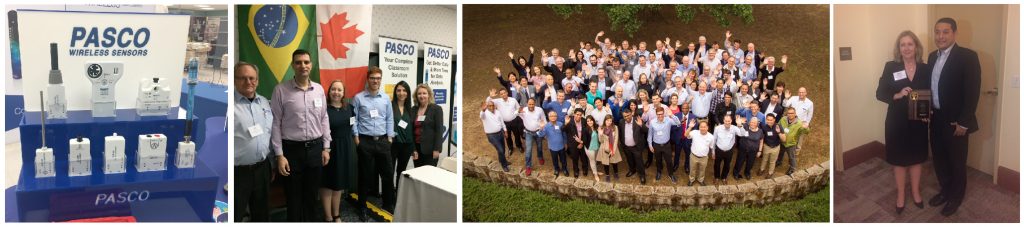
Six members of the AYVA Team spent last week in Roseville, California at PASCO Scientific’s headquarters.

We were excited to make new acquaintances and to reconnect with our friends from years gone by.

Representatives from more than 40 different countries had an opportunity to share success stories and receive training on PASCO’s latest products and new learning management software.

We even got a sneak peek at PASCO’s Roadmap for future development initiatives. A big shout out and thank you to our very gracious hosts at PASCO.

Measuring Headwinds and GPS Speed with PASCO’s New Wirelsss Weather Sensor

PASCO’s new wireless weather & environmental sensor with GPS provides for some obvious investigations such as monitoring changes in weather.  However, as this sensor measures 17 different parameters, there are almost countless ways that measurements can be used individually or in combination to explore the world.

Two of the weather sensor’s 17 measurements relate to speed – the wind speed and movement speed of the sensor itself (as provided by the GPS sensor).  Recognizing the similarity of these two measurements I was curious if the weather sensor’s GPS could be used to assess the accuracy of the weather sensor’s wind speed measurement.

GPS speed has proven to be very accurate, especially in open spaces, where there are no trees or buildings blocking satellite signals.  Therefore, using the GPS to evaluate the accuracy of the wind speed sensor is a reasonable test.

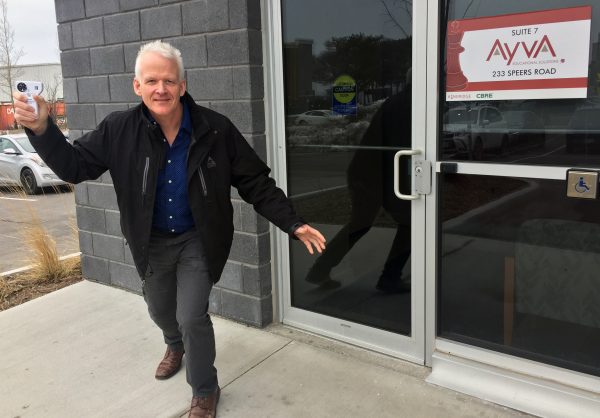
Without over thinking the experimental test, I decided to go for a quick run across our parking lot holding the sensor up in the air like a torch carrier in the Olympics (okay maybe I’m over-romanticizing) and see how the headwind I generate from my sprint correlates to the GPS Speed measurement.

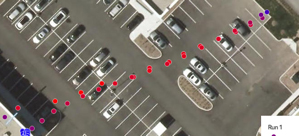
Being in less than optimum shape, after a long winter hiatus from anything resembling exercise, I kept my run to about 100 M (50 M in both directions).  Looking at the satellite image below that depicts my run (each dot is a separate measurement), you’ll see that there were cars in my way requiring several strenuous leaps.

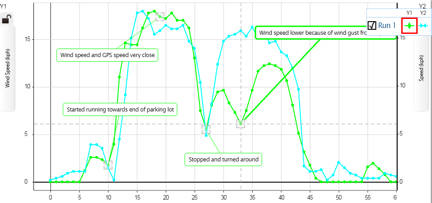
Notwithstanding the strange looks I received during my run, the test proved quite successful.  The graph below shows wind speed in green and GPS Speed in blue.  During the first half of the run the two speeds correlate very closely.  On my return however there is a significant difference which I suspect was caused by a trailing wind gust that would have the effect of reducing the headwind.

In conclusion it appears that the Weather Sensor measures wind speed fairly accurately. However, in this test the wind speed sensor is measuring headwind which is a combination of traveling speed and actual wind.  Therefore more rigorous testing would be required to make a fair assessment, with external sources of wind eliminated or at least accounted for (can you think of ways how this might be done?).

In the classroom I suspect the weather sensor will be used in many interesting ways that has little to do with weather.  In the months to follow I hope to share some more of my playful discoveries with this sensor.

Gauss Magnetism Accelerator: Grade 7 Science Project

Exploring Energy in Motion.
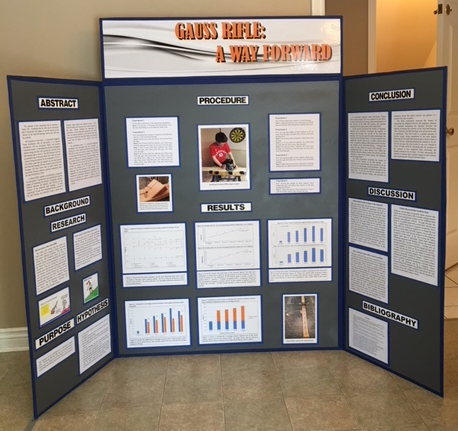
An amazing science fair project by Ryan V. of Oakville, Ontario.

If at first you don’t succeed, try-try again and this was exactly Ryan V’s attitude in completing his remarkable grade 7 science fair project on Magnetic Linear Accelerators.

The accelerator that Ryan built used a series of magnets and stationary marbles positioned in stages along a wooden track that resulted in a chain reaction with a final marble shooting off the end at an impressive speed.

Ryan was very interested in knowing the marble’s speed at various stages along the track and tried numerous techniques to take accurate measurements – however, all attempts were unsuccessful.

This is where AYVA and PASCO Scientific were able to help!  Using a PASCO Smart Gate and a Wireless Airlink Ryan was able to get the data he needed.

See the video for an excellent explanation and demonstration of how it all works.  No doubt Ryan will get an A++ for his hard work and persistence.

Products used:

Smart Gate

AirLink

Capstone

Untangle Your Circuits!

Making the leap from circuit diagrams to functioning circuits has never been so clear or intuitive. Circuits can be easily built and tested enticing students to more thoroughly explore the behavior of electricity. Your students will no longer be frustrated trying to trace out the electrical pathway through a nest of wires.

Supports inquiry learning – circuits can be easily modified and be quickly swapped out and rearranged

Compatible with both traditional and computer based labs – works with PASCO’s sensors as well as traditional Volt and Ammeters

Classroom management is a breeze – Storage is made simple with the included
Grattenels case and nesting trays

  • The 8 cm by 8 cm modules ensure that all students in a group can clearly see the completed circuit
  • Physical Components (resistors, batteries, switches, etc.) with identifying electronic symbols are visible on the surface of the modules
  • At a glance errors in a circuit can be quickly found without checking each connection

The Basic Kit includes enough modules to do 5 basic experiments:
  • Ohm’s Law
  • Series/Parallel Circuits
  • Batteries & Bulbs Circuits
  • Switches/Open/Closed Circuits
  • Electric Power & Energy

The Advanced Kit includes the Wireless Current & Voltage Sensors and modules for 7 additional experiments:
  • Kirchoff’s Laws
  • Electromagnets
  • Electromagnetic Induction
  • RC & RL circuits
  • Variable Resistance
  • LED Circuits
  • Electric Motors
SHARE YOUR CART